
Autistic Kids School Ride: When the Bus Doesn’t Work
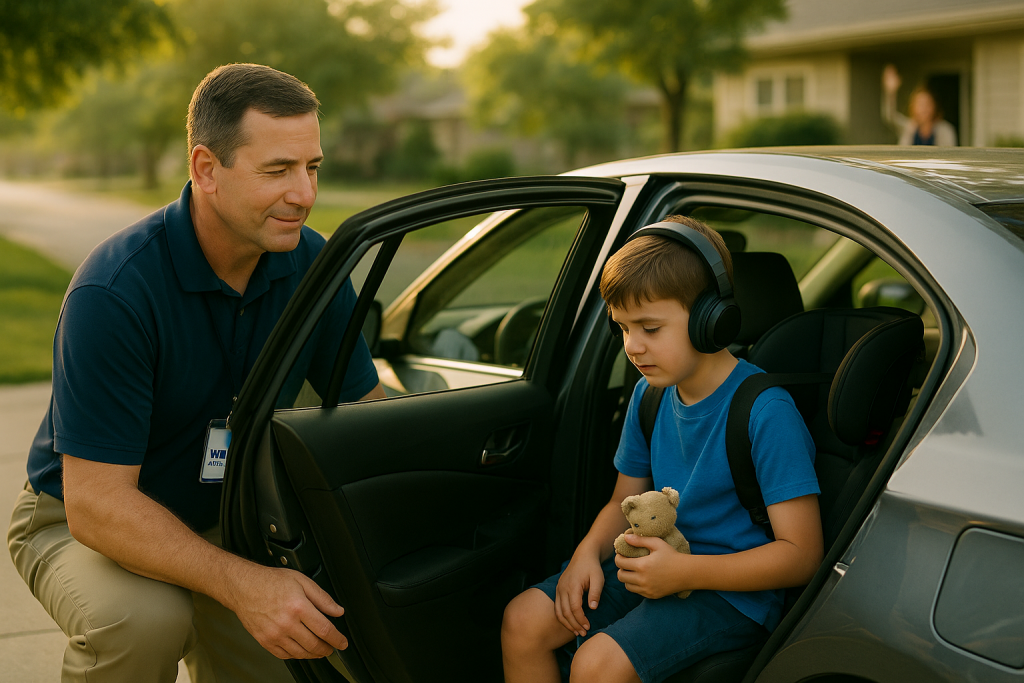
Your child can’t handle the school bus. You’ve tried. You really have. But the noise, the chaos, the unpredictability—it’s too much. Your kid gets on the bus already stressed, and by the time they get to school, they’re either shut down or melting down. The school calls. The bus driver is frustrated. Your child is miserable. And you’re stuck trying to figure out how to get them to school without destroying everyone’s morning.
The school bus isn’t designed for every child. For many autistic kids, it’s sensory hell. Too loud. Too crowded. Too many transitions. Too many variables. And when the bus doesn’t work, parents are left scrambling for alternatives.
That’s where an autistic kids school ride comes in—a private, one-on-one (or small group) transportation option that’s designed around your child’s specific needs instead of forcing them to fit into a system that wasn’t built for them.
This guide is for parents who are tired, overwhelmed, and just need something that actually works. We’re going to walk through why the bus fails so many autistic kids, what makes private transportation different, how to prepare your child for a new routine, what to look for in a driver, and how to make this transition as smooth as possible.
Why the School Bus Doesn’t Work for Many Autistic Kids
Let’s be honest about what the school bus experience actually is for many autistic children:
Sensory overload from the moment they step on.
The bus is loud. Kids are yelling. The engine rumbles. Brakes squeal. The radio might be on. Someone’s eating something that smells strong. The lighting is harsh. The seats are stiff and uncomfortable. For a child with sensory processing challenges, this isn’t just annoying—it’s physically painful. Their nervous system is in fight-or-flight mode before the bus even moves.
Unpredictability at every turn.
Autistic kids thrive on routine. The school bus is the opposite of routine. Different drivers substitute in. Routes change based on traffic or weather. Pickup times vary by a few minutes (which feels like chaos to a child who needs exactness). Other kids get on and off at different stops. The whole experience is a moving target, and for a child who needs predictability to feel safe, it’s overwhelming.
Forced social interaction.
Many autistic kids struggle with social demands. The bus forces them into close proximity with other children. They’re expected to navigate unwritten social rules: where to sit, who to talk to, how loud to be, how to handle teasing or bumping. For some kids, this is manageable. For others, it’s exhausting and anxiety-inducing before the school day even starts.
Multiple hard transitions in quick succession.
Autistic children often struggle with transitions—moving from one activity or environment to another. The school bus requires several transitions in a short span: home → outside → bus → bus seat → school → classroom. Each transition is a potential breaking point. By the time they reach the classroom, they’ve already burned through their emotional regulation capacity.
No accommodation for meltdowns or shutdowns.
If your child has a meltdown on the bus, the driver can’t pull over and give them space. There are other kids on the bus. There’s a schedule to keep. The driver might be empathetic, but they’re not equipped to handle it. Your child either has to hold it together (which is exhausting) or melt down in front of peers (which is humiliating and can lead to bullying).
According to the Centers for Disease Control and Prevention, approximately 1 in 36 children in the U.S. is diagnosed with autism spectrum disorder. Many of these children require individualized support to navigate daily routines, including transportation. For families seeking autistic kids school ride solutions, understanding why traditional methods fail is the first step toward finding what works.
What Makes an Autistic Kids School Ride Different
Private transportation for autistic kids isn’t just “a smaller bus.” It’s a fundamentally different approach. Here’s what changes:
Same driver, same car, same routine—every single day.
Your child gets picked up by the same person, in the same vehicle, at the same time, every day. There are no substitute drivers unless absolutely unavoidable (and even then, you’re notified in advance). The routine becomes predictable. Predictability reduces anxiety. Reduced anxiety means fewer meltdowns.
Controlled sensory environment.
The driver can adjust the environment to your child’s needs. Music off (or on, if your child prefers it). Windows up or down. Temperature controlled. No other kids making noise. No strong smells. The car becomes a calm, controlled space instead of a sensory assault.
Fewer transitions.
Instead of home → outside → bus stop → bus → school, the transition is simplified: home → car → school. One less step. One less thing to navigate. That might not sound like much, but for an autistic child, reducing transitions can make the difference between a good morning and a terrible one.
Flexibility for meltdowns.
If your child is having a hard time, a private driver can pull over safely, give them space, wait until they’re calm, and then continue. There’s no pressure from other kids. No tight schedule that can’t be adjusted by five minutes. The driver can adapt to what your child needs in that moment.
Communication tailored to the child.
Some autistic kids are verbal and chatty. Some are nonverbal. Some need silence. Some need clear, direct instructions. Some need visual schedules. A private driver learns your child’s communication style and adapts. They’re not managing 30 kids with 30 different needs—they’re focused on your child.
Parent involvement and feedback.
With private autistic kids school ride services, you communicate directly with the driver. You can give them information about what calms your child, what triggers them, what worked yesterday, what didn’t. The driver can text you updates. You’re not sending your kid into a black box and hoping for the best.
How to Prepare Your Autistic Child for a New School Ride Routine
Switching from the bus to private transportation is a transition—and transitions are hard for autistic kids. Here’s how to make it smoother:
Create a social story.
A social story is a simple, visual narrative that explains what’s going to happen. You can write it or find templates online. Example: “Every morning, [Driver’s name] will come to our house in a [color] car. I will get in the back seat. [Driver’s name] will drive me to school. When we get to school, I will get out and go to my classroom.”
Include photos of the driver, the car, and the route if possible. Read the social story with your child several times before the first ride. This helps them know what to expect.
Do a practice run.
Before the first actual school day, arrange a practice ride with the driver. Your child gets in the car, meets the driver, takes a short drive around the neighborhood, and gets out. No pressure. No school. Just familiarization. This reduces the anxiety of “new” on the first real day.
Identify sensory accommodations.
Talk to your child (if they’re verbal) or observe their sensory preferences. Do they need noise-canceling headphones? A favorite stuffed animal or fidget toy? A specific seating position (window seat, middle seat)? A blanket? Communicate these needs to the driver ahead of time.
Set up a visual schedule.
Many autistic kids benefit from visual schedules that show the sequence of their day. Include the car ride as part of the schedule. Use pictures or icons. Laminate it so your child can carry it with them. This gives them a sense of control and predictability.
Communicate with the driver about triggers and calming strategies.
Tell the driver what sets your child off (loud noises, sudden movements, certain topics of conversation) and what calms them down (deep pressure, counting, listening to a specific song, looking out the window). The more the driver knows, the better they can support your child.
Expect an adjustment period.
The first few rides might not be perfect. Your child might be anxious. They might test boundaries. They might have a meltdown. That’s normal. Give it time. Most kids adjust within a week or two once the routine becomes predictable.
What to Look for in a Driver for Autistic Kids School Ride
Not every driver is equipped to handle autistic kids school ride responsibilities. Here’s what separates a good driver from someone who’s just “nice with kids”:
Patience—real, deep, unshakable patience.
This isn’t about being friendly or cheerful. It’s about staying calm when a child is screaming, refusing to buckle, or having a meltdown. It’s about not getting frustrated when the same issue happens three days in a row. It’s about understanding that behavior is communication, and your job is to stay steady.
Training in autism, sensory needs, or special education.
A driver who’s been trained in autism spectrum support, sensory processing, or special education will understand why your child does what they do. They’ll know that a meltdown isn’t “bad behavior”—it’s nervous system overload. They’ll know how to de-escalate without making it worse.
Willingness to follow the child’s routine exactly.
Autistic kids often need things done a specific way. Maybe your child needs the driver to count to three before starting the car. Maybe they need to touch the seatbelt buckle twice before clicking it in. Maybe they need the driver to say the same greeting every single morning. A good driver doesn’t dismiss these needs as “silly”—they follow them, because they understand that routine is safety for your child.
Clear, direct communication.
Autistic kids often struggle with ambiguous language. A good driver will speak clearly and literally. “We’re going to leave in two minutes” instead of “We’re leaving soon.” “I’m turning left at the next street” instead of surprising the child with a turn. No sarcasm. No idioms. Just clear, predictable language.
Consistency—the same person, every day.
Substitute drivers should be rare. Your child needs to know that the same person is picking them up every morning. If a substitute is unavoidable, you should be notified in advance, and the substitute should be introduced (ideally in person or through a photo) before the first pickup.
Daily communication with parents.
A good driver will text or call you if something unusual happened. “Your child had a tough morning, but we made it to school fine.” “Your child was really happy today—they told me about their new game.” You should feel like you’re in the loop, not guessing how the ride went.
The Autism Society provides resources for families navigating daily challenges, including transportation. When searching for autistic kids school ride services, parents should prioritize providers who demonstrate understanding of autism-specific needs, not just general childcare experience.
Real Scenarios and How Trained Drivers Handle Them
Let’s get specific. Here are actual situations that come up with autistic kids school ride services, and how a trained driver handles them:
Scenario 1: Child refuses to get in the car.
What doesn’t work: Forcing, bribing, or getting frustrated.
What a trained driver does: Stays calm. Gives the child space. Offers a choice: “Do you want to get in now, or would you like one more minute?” If the child still refuses, the driver communicates with the parent. They don’t rush. They don’t make it a power struggle. They understand that refusal is communication—maybe the child is anxious, maybe something changed in the routine, maybe they’re not feeling well.
Scenario 2: Meltdown during the ride.
What doesn’t work: Telling the child to “calm down,” raising your voice, or trying to reason with them.
What a trained driver does: Pulls over in a safe location. Turns off the music. Lowers their voice. Gives the child space. Doesn’t try to talk the child out of the meltdown. Waits. Once the child begins to regulate, the driver offers a calming strategy the parent provided (deep breaths, counting, holding a fidget toy). They don’t resume driving until the child is calm enough to continue safely.
Scenario 3: Sensory overload from unexpected traffic noise.
What doesn’t work: Ignoring the child’s distress or telling them “it’s fine.”
What a trained driver does: Notices the child covering their ears or becoming agitated. Immediately adjusts the environment—rolls up windows, turns off any music, takes a quieter route if possible. Acknowledges the child’s distress: “I know that noise is hard. We’re going to make it quieter.” Doesn’t dismiss the sensory issue.
Scenario 4: Child needs their routine disrupted (construction detour).
What doesn’t work: Surprising the child with the route change without warning.
What a trained driver does: Texts the parent the night before (if known) or calls that morning to explain there’s a detour. Uses a visual or verbal explanation for the child: “We usually turn left at the red house, but today there are big trucks blocking the road. We’re going to turn right instead and take a different street. We’ll still get to school.” Gives the child time to process the change. Stays calm if the child is upset about the change.
Scenario 5: Child is nonverbal and seems uncomfortable.
What doesn’t work: Guessing, ignoring the discomfort, or over-talking.
What a trained driver does: Watches for body language and behavioral cues. Checks basics: is the seatbelt too tight? Is the sun in their eyes? Is the temperature uncomfortable? Tries one adjustment at a time. Communicates with the parent after drop-off: “Your child seemed uncomfortable today—pulling at the seatbelt. I loosened it slightly. Let me know if that’s okay or if I should check something else.”
These aren’t hypothetical. These are situations that actually happen. Drivers who are trained, patient, and genuinely understand autism handle them without making the situation worse. Drivers who aren’t trained often escalate things unintentionally.
Why Some Drivers (Like Veterans) Excel at Autistic Kids School Ride
Here’s something that doesn’t get talked about enough: certain types of people are naturally better at autistic kids school ride work, and veterans are often among them. Here’s why:
They’re trained to stay calm under pressure.
Autistic meltdowns can be loud, intense, and unpredictable. Veterans have been trained to manage high-stress situations without losing composure. They don’t panic. They don’t escalate. They stay steady—which is exactly what an autistic child needs.
They follow protocols without cutting corners.
Autistic kids need routines followed exactly. Veterans understand that protocols exist for a reason, and they don’t deviate. If the routine is “count to three before starting the car,” they count to three every single time. No shortcuts. No “close enough.”
They’re comfortable with silence.
Many autistic kids don’t want conversation. They want quiet. Veterans are comfortable with silence. They’re not going to feel awkward and try to fill the space with chatter. They’ll give the child the quiet they need.
They’re trained in de-escalation.
Veterans often receive training in conflict de-escalation and crisis management. Those skills translate directly to managing behavioral challenges. They know how to lower their voice, give space, remove triggers, and wait out a storm without making it worse.
They communicate clearly and literally.
Military communication is direct and unambiguous. No sarcasm. No idioms. No vague instructions. That communication style works extremely well with autistic kids, who often struggle with figurative language and need clear, literal statements.
They take responsibility seriously.
Veterans understand what it means to be responsible for someone else’s safety. They don’t take shortcuts. They don’t get complacent. When a parent trusts them with their autistic child, they take that responsibility seriously.
Not every veteran is a perfect fit for autistic kids school ride work, and not every great driver is a veteran. But there’s a reason many families specifically request veteran drivers once they’ve experienced the difference.
Questions to Ask Before Hiring Someone for Autistic Kids School Ride
If you’re considering private transportation for your autistic child, here are the questions you need to ask before committing:
What training do you have in autism or sensory needs?
You’re looking for specific answers here—not “I’m good with kids.” You want to hear about actual training: autism spectrum support, sensory processing, IEP familiarity, de-escalation techniques, special education experience.
Will my child have the same driver every day?
Consistency is critical. If the answer is “usually” or “most of the time,” that’s a red flag. You want a driver who commits to being the consistent person unless there’s an emergency.
What happens if my child has a meltdown during the ride?
A good answer includes: pull over safely, give the child space, use calming strategies the parent provided, wait until the child is calm, communicate with the parent afterward. A bad answer is anything that sounds dismissive or punitive.
How do you communicate with parents?
You want daily updates—even brief ones. “Pickup went smoothly.” “Your child had a tough morning but was calm by drop-off.” You should feel like you’re in the loop, not guessing.
Can we do a trial run before committing?
A good provider will say yes. You want your child to meet the driver, see the car, and take a practice ride before the first real school day.
What sensory accommodations can you make?
The driver should be willing to adjust music, temperature, windows, seating, and anything else your child needs. If they push back on accommodations, that’s a red flag.
What do you do if my child refuses to get in the car?
You’re looking for patience and communication. “I stay calm, give them time, offer choices, and if needed, contact the parent.” You don’t want to hear “I convince them” or “I get them in.”
How do you handle schedule disruptions (traffic, detours, emergencies)?
A good driver will explain that they communicate proactively—texting the parent, preparing the child for changes when possible, staying calm if the child is upset about the disruption.
What’s your policy on substitutes?
You want substitutes to be rare, pre-announced, and ideally introduced to your child before the first ride. If the answer is “we use substitutes regularly,” that’s not ideal for an autistic child who needs consistency.
Can you provide references from other families with autistic kids?
If the driver has experience with autistic kids school ride services, they should be able to provide references (with permission) from other families.
The Financial Reality: What Autistic Kids School Ride Services Cost
Let’s talk about money, because this is a huge factor for families.
Private transportation is more expensive than the school bus.
The school bus is usually free (covered by the district). Private autistic kids school ride services are not. Depending on your location, you might pay $15–$40 per ride, or $150–$400 per week for daily service.
Some costs may be covered by your child’s IEP.
If your child has an IEP (Individualized Education Program), transportation can be included as a related service. If the school district agrees that the school bus is not appropriate for your child, they may be required to cover private transportation. This is worth exploring with your school district’s special education team.
Some insurance plans or Medicaid waivers cover transportation.
Depending on your state and your child’s diagnosis, some insurance plans or Medicaid waivers cover non-emergency medical transportation, which can include school transportation for kids with disabilities. Check with your insurance provider.
It’s expensive, but for many families, it’s worth it.
Parents consistently say that private autistic kids school ride services are one of the best investments they’ve made. When the alternative is your child melting down every morning, missing school, or starting the day in crisis, the cost becomes worth it.
According to the U.S. Department of Education, schools are required to provide a free and appropriate public education (FAPE) to students with disabilities, which includes necessary related services like transportation. If the general education bus is not appropriate for a child’s needs, the district may be obligated to provide or fund alternative transportation.
Frequently Asked Questions About Autistic Kids School Ride
How much does private school transportation for autistic kids cost?
Costs vary by location and provider, but the school district covers cost for these rides, some families also share costs through carpooling with other families. Get in touch with your school district.
Will my child's IEP cover private transportation?
It depends. If the IEP team determines that your child requires specialized transportation as a related service, the school district may be required to provide or fund it. You'll need to advocate for this during IEP meetings.
What if my child is nonverbal?
A trained driver will communicate through other means: visual schedules, gestures, observing body language, and working closely with you to understand your child's communication style. Nonverbal doesn't mean unable to communicate.
Can siblings ride together?
Often, yes. If you have multiple children (autistic or not), many private transportation services can accommodate siblings in the same ride. This can actually reduce costs and make the routine easier.
How do I transition my child from the bus to a private ride?
Use social stories, do practice runs, maintain as much routine as possible, and give your child time to adjust. Most kids adapt within 1–2 weeks once the new routine becomes predictable.
Final Thoughts: When the Bus Doesn’t Work, There Are Alternatives
If your autistic child can’t handle the school bus, you’re not alone. Thousands of families face this exact problem. The school bus system works for many kids, but it wasn’t designed with autistic children’s sensory, behavioral, and routine needs in mind.
Private autistic kids school ride services exist to fill that gap. They’re not perfect. They’re more expensive. But for many families, they’re the difference between a child who can attend school successfully and a child who’s in crisis before they even get there.
You deserve support. Your child deserves transportation that works for them, not transportation that makes everything harder.
If you’re exhausted from trying to make the bus work, it’s okay to stop trying. There are alternatives. You’re allowed to choose what’s best for your child, even if it’s not what everyone else does.
Need reliable transportation for your autistic child? Let’s talk.
Yuni Rides specializes in consistent, sensory-friendly student transportation. We train our drivers to support kids with autism and other needs.
→ Learn More About Our Services
Questions about how this works for your child? Call us.
We’ll walk you through the process, answer your questions, and help you figure out if private transportation is the right fit.
→ Contact Us: (415) 535-2155
Want to learn about our driver training?
See how we prepare drivers to support students with autism, sensory needs, and IEPs.
→ Explore Driver Training
One child at a time. One calm morning at a time. One ride that actually works.
This is what autistic kids school ride services are for—not replacing what works, but providing an alternative when it doesn’t.