
Second Income Driving Jobs: Why School Transportation Beats Uber
Marcus downloaded the rideshare app two years ago when he needed extra money. His main job as a high school history teacher paid the bills, but barely. Student loans, rent in a Chicago suburb, and trying to save something for the future—it all required more income. So he started driving for rideshare services on weekends and evenings.
At first, the flexibility seemed perfect. Drive when he wanted, make decent money, easy gig. But six months in, reality hit. He was putting 300+ miles a week on his car—miles that didn’t pay for themselves. Gas prices spiked. His insurance premiums increased when he added rideshare coverage. He spent $1,200 on new tires, $800 on brake repairs, and watched his car’s value drop faster than the payments on his loan.
Then he did the math. After expenses, he was making about $12 an hour. For context, the average Uber driver income is approximately $11.77 per hour after accounting for Uber fees and other expenses. He was working 15 hours a week for income that barely justified the wear on his vehicle and his mental energy.
That’s when Marcus discovered second income driving jobs that actually work—specifically, school transportation. Not driving a school bus (no CDL required), but providing private car transport for students who need individualized rides to school. The economics were completely different. The schedule fit his teaching schedule. The wear on his car dropped to almost nothing. And for the first time since he started looking for second income driving jobs, he was making money that actually improved his financial situation instead of just treading water.
Why Most Second Income Driving Jobs Don’t Deliver What They Promise
The gig economy sells a compelling story: be your own boss, work when you want, make great money. But for most second income driving jobs in the rideshare and delivery space, the reality doesn’t match the marketing. Here’s what drivers discover after a few months:
The Hidden Cost Problem
Rideshare and delivery apps advertise gross earnings—the amount you make before expenses. But those earnings figures don’t account for paying for gas, maintenance, depreciation, insurance, and other costs of using your vehicle for work. These costs aren’t small:
Gas: Driving all day for rideshare or deliveries can easily consume $30-$50 in gas daily. At 15 hours a week, that’s $200-$300/month just in fuel.
Maintenance: Oil changes every 3,000 miles instead of 5,000. New tires twice as often. Brakes wearing faster. These costs add up to $1,500-$2,500 annually for high-mileage drivers.
Depreciation: The biggest hidden cost. A car driven 15,000 personal miles plus 15,000 rideshare miles annually depreciates far faster than a car with typical mileage. That’s $3,000-$5,000 in lost vehicle value per year.
Insurance: Rideshare insurance additions cost $15-$30/month minimum. Some drivers discover their personal insurance doesn’t cover them during app-active periods and face massive gaps in coverage.
According to a recent policy report on rideshare driver earnings, the average income a driver receives after accounting for Uber fees and other expenses comes to only $11.77 an hour. During slower periods, many drivers report earning as little as $4.50 per hour after all expenses. That’s not a second income, that’s working for less than minimum wage while destroying your car.
The Unpredictability Factor
Second income driving jobs with rideshare apps promise flexibility, but deliver unpredictability:
Inconsistent earnings: One weekend you make $200 in 10 hours. The next weekend you make $85 for the same time because demand dropped or too many drivers were online.
Surge dependency: Higher earnings depend on surge pricing, which means working during the busiest, most stressful times—Friday/Saturday nights, bad weather, major events—when you’re competing with hundreds of other drivers for rides.
Dead time: According to Gridwise driver insights, drivers typically experience significant dead time between rides—sitting in parking lots waiting for ride requests, driving to pickup locations with no compensation, repositioning to higher-demand areas. That unpaid time drastically reduces effective hourly earnings.
Algorithm changes: Rideshare platforms constantly adjust their algorithms and pricing. Drivers report that earnings steadily decrease over time as platforms prioritize cheaper rides for passengers and take larger cuts from driver pay.
The Reality of “Flexibility”
The supposed flexibility of second income driving jobs in the gig economy comes with hidden costs:
You’re always on call: To make decent money, you need to be available during peak demand times, which means your schedule revolves around when the app needs you, not when you want to work.
No benefits: No health insurance, no paid time off, no retirement contributions. You’re covering all of these yourself while trying to earn extra income.
Tax complexity: As a 1099 contractor, you’re responsible for quarterly estimated tax payments, self-employment tax (15.3% on top of income tax), and tracking every mile and expense for deductions. Many drivers discover at tax time that they owe thousands because they didn’t set aside enough money.
Customer rating pressure: One bad rating from a difficult passenger can threaten your access to the platform. You’re serving customers who have all the power in the relationship.
For people seeking second income driving jobs, this combination of unpredictable earnings, high vehicle costs, and hidden complexity often means they’re working harder for less money than they expected—and sometimes actually losing money once all costs are calculated.
What Makes School Transportation Different: Second Income Driving Jobs That Actually Work
School transportation driving offers everything gig economy apps promised but failed to deliver. Here’s why it’s one of the few second income driving jobs that makes financial sense:
Predictable Routes, Predictable Pay
Unlike rideshare driving where you never know where you’re going or what you’ll earn, school transportation routes are consistent:
Same route, every day: You pick up the same student(s) at the same location, drive the same path to school, drop off, and you’re done. No guessing, no dead time driving around looking for rides, no algorithm deciding if you get a trip.
Set schedule: Morning routes typically run 6:30-8:30 AM. Afternoon routes run 2:30-4:30 PM. You know exactly when you’re working, how long it takes, and when you’re free. This is crucial for people who need second income driving jobs that fit around a primary job or other commitments.
Weekly pay, guaranteed: You’re paid weekly for completed routes regardless of “demand” or “surge.” No waiting to hit a minimum threshold before cashing out. No worrying that this week will be slow. You complete your routes, you get paid.
Typical Earnings by Schedule
Morning routes only (10 hours/week):
2 rides × $40 × 5 days = $400/week = $1,600/month net (after minimal gas/maintenance)
Afternoon routes only (10 hours/week):
2 rides × $40 × 5 days = $400/week = $1,600/month net
Both morning AND afternoon (20 hours/week):
4 rides daily × $40 × 5 days = $800/week = $3,200/month net
Referral bonus: Refer another driver who completes onboarding and gets on the road = $30 one-time bonus per referral. Build your network, earn extra.
In California and other markets, base fares vary by distance:
- $30 for 1-6 miles
- $35 for 7-12 miles
- $40 for 12-20 miles
- $1 per additional mile after 20 miles
Illinois currently offers the strongest starting pay: $40 base fare regardless of distance for most routes, making it one of the best second income driving jobs in the Chicago metro area.
Lower Mileage = Lower Costs
According to IRS standard mileage rates, the cost of operating a vehicle for business purposes is $0.67 per mile in 2024, which means school transportation routes averaging 50-75 miles weekly cost $33-50 compared to rideshare’s 200-300 weekly miles costing $134-200. One of the biggest advantages of school transportation as second income driving jobs is the dramatically lower impact on your vehicle:
Short, defined routes: Most school routes are 5-15 miles from pickup to drop-off. Compare that to rideshare driving where you might drive 50+ miles in a shift between rides, repositioning, and dead time.
Limited weekly mileage: A typical morning route driven 5 days a week is 50-75 miles total per week. Rideshare drivers easily do 200-300 miles weekly. That’s 3-4 times less wear on your vehicle.
No evening/night driving: School routes happen during daylight hours with good visibility and lower accident risk compared to late-night rideshare driving in bar districts.
Predictable maintenance: You can plan oil changes, tire rotations, and other maintenance based on consistent mileage instead of emergency repairs from unexpected high-mileage weeks.
Lower mileage means lower gas costs, less frequent maintenance, slower depreciation, and potentially lower insurance costs. For second income driving jobs, this is critical—you need your earnings to be profit, not just covering vehicle expenses.
No Customer Rating Anxiety
In rideshare, a few bad ratings from difficult passengers can cost you access to the platform. In school transportation:
District contracts, not individual customers: You’re not serving individual customers who rate you. Districts contract with transportation providers, and your performance is evaluated professionally, not through a 5-star rating app.
Long-term relationships: You’re driving the same students daily, building rapport with families. Parents appreciate consistency. Students feel comfortable with a familiar driver. This stability is the opposite of the transactional, rating-driven anxiety of rideshare work.
Professional support: When issues arise (traffic delays, vehicle problems, student behavior), you have dispatch support and clear protocols to follow. You’re not alone in a parking lot trying to de-escalate a situation with no backup.
For many people considering second income driving jobs, the difference between serving anonymous app users who can tank your rating and building relationships with families who value consistency is significant.
It’s Actually Meaningful Work
This might seem soft, but it matters: school transportation driving means something.
Marcus, the teacher who switched from rideshare to school transport, puts it this way: “With rideshare, I was an algorithm-managed taxi service. With school transport, I’m helping a kid with autism get to school safely every morning. His parents trust me. The kid recognizes my car and feels comfortable. When I pick him up, his mom can go to work without worrying. That’s different.”
Second income driving jobs that feel meaningful are easier to sustain. You’re less likely to burn out. You’re more likely to take pride in doing the job well. And for many drivers, knowing their work helps kids access education makes the early mornings worthwhile.
Morning Routes: The Perfect Second Income Schedule
For most people seeking second income driving jobs, morning school routes offer an ideal schedule:
Done by 9 AM: Morning routes typically run 6:30-8:30 AM. You finish before most main jobs even start. This makes it perfect for:
- People with 9-5 jobs who want extra income without sacrificing evenings/weekends
- Stay-at-home parents who need to be available during the school day
- College students with late-morning or afternoon classes
- Retirees who prefer early mornings and want their afternoons free
No weekend work: School transportation operates on school schedules, which means Monday-Friday only. Your weekends are free—no pressure to “maximize earnings” by working Friday/Saturday nights like rideshare drivers face.
No late nights: Unlike rideshare or delivery work where peak earnings happen late at night, school transportation happens during normal waking hours. No bar pickups at 2 AM. No driving exhausted after a full day at your main job.
Consistent schedule: You know weeks in advance when you’re working. No checking an app hoping for surge pricing. No scrambling to make up for a slow week. Monday through Friday, same time, same route.
For second income driving jobs, this schedule predictability is invaluable. You can plan your life around it instead of your life revolving around chasing app-based earnings.
Real Earnings Comparison: School Transportation vs. Rideshare
Let’s compare real numbers for second income driving jobs. Here’s what a driver working 10 hours per week would earn in each model:
Rideshare (20 hours/week scenario):
Gross earnings: Median around $20/hour = $400/week gross
Minus expenses:
- Gas: $80/week (300+ miles driven)
- Maintenance/repairs (prorated): $60/week
- Depreciation (prorated): $120/week
- Extra insurance: $7/week
- Total expenses: $267/week
Net earnings: $133/week = $6.65/hour actual take-home
Time commitment: 20 hours driving + 4 hours waiting for rides + 2 hours cleanup = 26 hours total
School Transportation Illinois (20 hours/week scenario – both morning AND afternoon):
Here’s the actual math in Illinois:
Morning block (6:30-8:30 AM): 2 rides × $40 = $80 daily
Afternoon block (2:30-4:30 PM): 2 rides × $40 = $80 daily
Daily total: $160
Weekly (5 days): $800/week
Monthly: $3,200
Minus expenses:
- Gas: $20/week (100 miles total, short predictable routes)
- Maintenance/repairs (prorated): $15/week
- Depreciation (prorated): $40/week
- Insurance: minimal or covered
- Total expenses: $75/week
Net earnings: $725/week = $36.25/hour actual take-home
Time commitment: 20 hours driving (4 hours daily), no waiting time, no cleanup needed
If you only want mornings OR afternoons (not both):
- 10 hours/week = $400/week = $1,600/month net
- Still $40/hour net after expenses
The difference is stark: school transportation drivers in Illinois net 5-6 times more per hour than rideshare drivers when you account for actual expenses and time. For second income driving jobs, that difference is the gap between genuinely improving your financial situation and just staying busy for pennies.
Who School Transportation Works For: Second Income Driving Jobs Across Life Stages
School transportation appeals to different people for different reasons, but they all share one thing: they need second income driving jobs that actually deliver profit without destroying their vehicle or schedule.
Teachers and Education Professionals
Why it works: Morning routes before school starts or afternoon routes after dismissal fit perfectly around teaching schedules. Summer off aligns with school transport needs. Many teachers already work with kids and understand IEPs, special needs, and classroom management—skills that transfer directly to transporting students.
Typical earnings in Illinois: $400/week for morning OR afternoon routes, $800/week for both = $1,600-$3,200/month
Stay-at-Home Parents
Why it works: Drop your own kids at school, drive a morning route (6:30-8:30 AM), be home by 9 AM. Or drive an afternoon route (2:30-4:30 PM) before picking up your own kids. School transportation is one of the few second income driving jobs that actually fits around family schedules without requiring childcare.
Typical earnings in Illinois: $400/week for one route block = $1,600/month
Retirees
Why it works: Early mornings are often when retirees are already awake. Routes provide structure, social interaction, and purpose. Physical demands are manageable (no heavy lifting, reasonable activity level). Income supplements fixed retirement funds without the chaos of rideshare work.
Typical earnings in Illinois: $400/week for morning routes, with option to add afternoon routes for $800/week total = $1,600-$3,200/month
Veterans and First Responders
Why it works: Skills from military or emergency services (protocol adherence, calm under pressure, reliable execution) translate perfectly to school transportation. Many veterans seek second income driving jobs with structure and meaning rather than gig economy chaos. The work provides clear mission and routine.
Typical earnings in Illinois: $400-$800/week depending on route schedule = $1,600-$3,200/month. Veterans often excel quickly and may qualify for routes requiring specialized training (special needs transport).
For more on why veterans choose school transportation, see our guide on veteran opportunities in student transportation.
Career Changers Exploring Options
Why it works: School transportation lets you test whether driving work suits you without the high-pressure, high-mileage commitment of rideshare. Low barrier to entry (no CDL required), immediate earnings, and clear expectations make it one of the best second income driving jobs for people exploring whether this type of work fits their lifestyle.
Typical earnings in Illinois: Start with one route block ($400/week = $1,600/month) and scale up to both blocks ($800/week = $3,200/month) if it works for your schedule
How to Get Started with School Transportation: Second Income That Actually Works
If you’re done with gig economy promises that don’t deliver and you want second income driving jobs that make financial sense, here’s how to transition to school transportation:
Requirements (Lower Than You Think)
No CDL required: Private school transportation uses regular cars, SUVs, and minivans—not commercial buses. Your standard driver’s license is sufficient. This is a major barrier removed compared to traditional school bus driving.
Clean driving record: No major violations in the past 3-5 years. DUIs typically disqualify. Standard speeding tickets are usually okay if not excessive.
Background check: Standard criminal background check required (same as any job working with children). Nothing more invasive than rideshare apps require.
Insurance: Personal auto insurance plus verification that your vehicle meets safety standards. Some providers offer insurance coverage; others require specific policy additions.
Vehicle requirements: Reliable sedan, SUV, or minivan. Clean, safe, properly maintained. No specific age limit as long as vehicle passes safety inspection.
Learn more about complete student transportation driver requirements.
The Application Process
Step 1: Apply with a school transportation provider like Yuni Rides who contracts with school districts. Application takes 10-15 minutes online. Apply Here
Step 2: Background check and driving record review (1-2 weeks processing time).
Step 3: Training on child safety protocols, car seat installation, communication procedures, and route logistics (2-3 hours, usually paid).
Step 4: Route assignment based on your availability and location. Most drivers start with one morning or afternoon route.
Step 5: Orientation with your assigned student(s) and their families before the first official day. Meet parents, learn any special needs or preferences, practice the route.
Step 6: Start driving and earning weekly pay immediately.
Total timeline from application to first paycheck: typically 2-3 weeks.
What Training Covers
Unlike rideshare where you download an app and start driving immediately (often learning hard lessons later), school transportation provides actual training:
Safety protocols: Car seat and booster seat installation, securement systems, curbside handoff procedures, never leaving a child unattended.
Communication: How to use the provider’s app for reporting delays, messaging parents, documenting rides. Clear escalation procedures for any issues.
Special needs basics: Overview of common disabilities you might encounter (autism, ADHD, mobility challenges), communication strategies for nonverbal students, de-escalation techniques for behavioral challenges.
Route planning: How to optimize your route for efficiency, what to do if road closures affect your path, backup plans for vehicle issues.
This training isn’t just checking boxes—it’s equipping you to do the job well and feel confident. For people considering second income driving jobs, knowing you’ll be properly trained before your first route is reassuring.
Weekly Pay and Earnings Tracking
Payment frequency: Weekly direct deposit. No waiting until you hit a threshold like some gig apps require.
Earnings transparency: You know exactly what you’ll earn per route before you accept it. No algorithm adjusting your pay after the fact.
Tracking: Providers typically use apps to track your routes, mileage, and earnings. Everything is documented for your records and tax purposes.
Tax classification: You’re typically a W-2 employee (not 1099 contractor), which means taxes are withheld from your paycheck and you don’t owe self-employment tax. This is a significant advantage over rideshare taxation complexity.
For detailed earnings information, see our breakdown of how much school transportation drivers make.
Why Districts Partner With Private Transportation Providers
You might wonder: why do school districts contract with private transportation providers instead of hiring drivers directly? Understanding this helps you see why second income driving jobs in school transportation are stable and growing:
Driver shortage crisis: School districts nationwide face severe driver shortages. Traditional school bus systems can’t recruit enough CDL-licensed drivers for large buses. Private transportation fills the gap by using regular drivers with standard licenses.
Specialized needs: Students with IEPs, special needs, or behavioral challenges often require one-on-one or small-group transport that large buses can’t provide. Districts contract with private providers to deliver these specialized services.
Flexibility: Districts can scale transportation up or down as enrollment changes without maintaining excess vehicles and staff. Private providers manage fleets and driver scheduling.
Cost efficiency: For specialized routes with 1-3 students, maintaining a full school bus and CDL driver isn’t cost-effective. Private car transport delivers the same service at lower cost.
Legal obligations: Under federal law (IDEA, FAPE), districts must provide transportation for students who need it to access education. Private providers help districts fulfill this requirement when their own resources fall short.
This means school transportation jobs aren’t going away—demand is increasing as more families need specialized transport and districts struggle with driver shortages. For people seeking stable second income driving jobs, this growth translates to consistent opportunities.
Common Questions About Second Income Driving Jobs in School Transportation
Can I do school transportation AND rideshare?
Technically yes, but most drivers find they don’t need to. Morning school routes (6:30-8:30 AM) can be combined with afternoon routes (2:30-4:30 PM), earning $800-1,000/month. That plus a main job provides solid second income without the need to also grind on rideshare apps. Many drivers who switch from rideshare to school transport find they earn similar or better income with far less stress and vehicle wear.
What if I can only work mornings OR afternoons, not both?
That’s fine—and still profitable. Many drivers choose only morning routes (6:30-8:30 AM, 2 hours daily) because they want afternoons free, or only afternoon routes (2:30-4:30 PM) because they have morning commitments. In Illinois, one route block earns $400/week = $1,600/month net. That’s more than most rideshare drivers make working twice the hours. Providers accommodate your availability—you’re not pressured to work both blocks.
How long are the routes?
Most routes are 30-60 minutes from pickup to drop-off for morning runs, similar timeframe for afternoon pickup to drop-off. Total time commitment including drive to pickup location and return home: typically 2-2.5 hours per route block.
What if my car breaks down?
Most providers have backup systems. You’d contact dispatch, and they’d either provide a replacement vehicle or assign another driver to cover your route that day. You’re not stranded trying to fix your car while losing income like rideshare drivers face.
Do I need special insurance?
Requirements vary by provider. Some include insurance coverage as part of the contracted service. Others require you to add a commercial rider to your personal policy (usually $15-30/month). This is clarified during onboarding.
What about gas money?
Routes are short enough that gas costs are minimal compared to rideshare. Many drivers find that 10 hours of school transport costs less in gas than 10 hours of rideshare because you’re not constantly driving between rides or repositioning. Some providers offer mileage reimbursement; others factor gas costs into the pay rate.
What if I want to stop or take a break?
Give notice (typically 2-4 weeks) and you can pause or stop anytime. No penalties. No worrying about “deactivation” like with rideshare apps. Life changes, schedules shift—providers understand that second income work needs to flex with your circumstances.
Making the Switch: From Gig Economy Chaos to Stable Second Income
If you’re currently driving for rideshare or delivery apps and burning out on the unpredictability, low earnings, and vehicle destruction, here’s how to transition:
Week 1: Apply with a school transportation provider. Submit your application, driving record, and vehicle information. This takes 15 minutes and costs nothing.
Week 2-3: Background check processes. While you wait, continue your current driving work but start tracking actual net earnings (gross minus all expenses). You’ll likely confirm that your effective hourly rate is much lower than you thought.
Week 3-4: Complete training, meet your route assignment, do orientation with families.
Week 4: Start driving school routes. You can temporarily overlap with rideshare work to ensure you’re comfortable with the new schedule and earnings.
Week 5+: Most drivers phase out rideshare entirely once they confirm school transport earnings are consistent and their vehicle costs have dropped dramatically.
The key is that you don’t have to quit one to try the other. You can test school transportation while keeping rideshare as a backup. But most drivers who make the switch don’t look back—the stability, lower costs, and meaningful work make it clear which model actually works as second income driving jobs.
Why Yuni Rides: The School Transportation Provider That Respects Drivers
Yuni Rides partners with school districts across Illinois and California to provide specialized student transportation. We work with drivers who want second income opportunities that make sense:
Weekly pay, always on time: Direct deposit every week for completed routes. No minimum thresholds to hit before you get paid.
Flexible scheduling: Morning only, afternoon only, or both—your choice based on availability. No pressure to work when you don’t want to.
Training and support: Comprehensive onboarding on safety protocols, special needs support, and route management. Ongoing support from dispatch when issues arise.
Vehicle flexibility: We work with sedans, SUVs, and minivans. You don’t need a specific type of vehicle, just something safe and reliable.
Real relationships: You’re assigned consistent routes with the same students daily. You build rapport with families. You’re treated like a professional, not an algorithm-managed contractor.
Many of our drivers switched from rideshare apps after realizing they were working harder for less money and destroying their vehicles in the process. They stay with Yuni Rides because school transportation is one of the few second income driving jobs that delivers what it promises: predictable earnings, reasonable vehicle wear, meaningful work, and respect for your time.
Ready to explore school transportation as your second income?
- Learn more about becoming a student transportation driver
- See complete driver requirements
- Apply to drive with Yuni Rides
- Contact us with questions
The Bottom Line on Second Income Driving Jobs
Second income driving jobs aren’t all created equal. Rideshare and delivery apps promise flexibility and good earnings but deliver unpredictable income, high vehicle costs, and algorithm-driven stress. The math doesn’t work for most drivers once expenses are factored in.
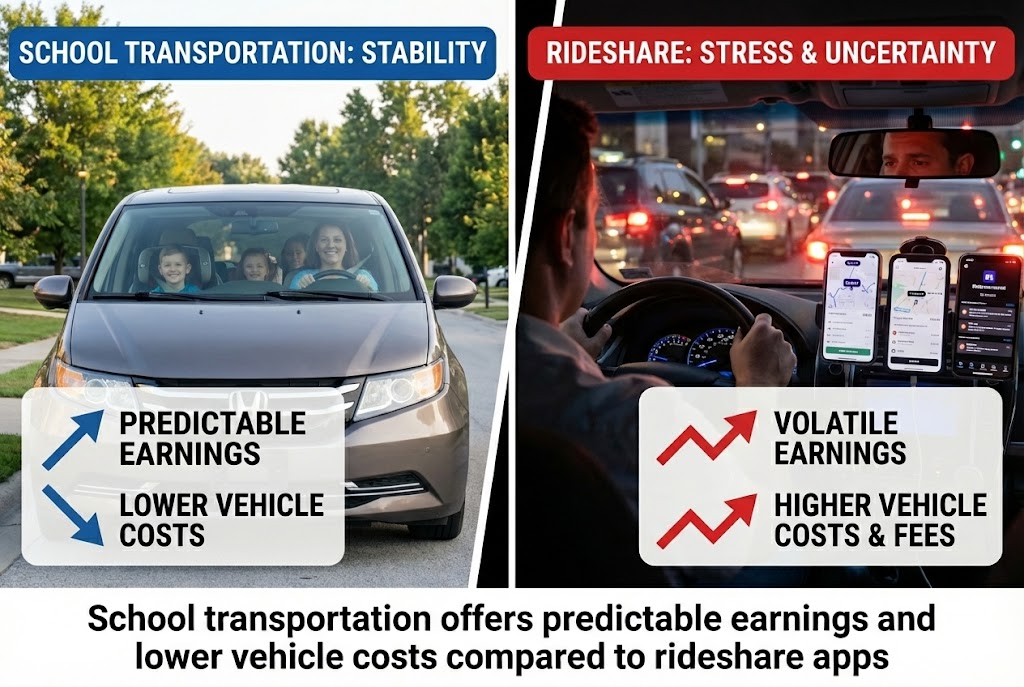
School transportation offers an alternative: predictable routes, consistent weekly pay, dramatically lower vehicle wear, and work that feels meaningful. For teachers, parents, retirees, veterans, and anyone seeking stable second income without the gig economy grind, it’s one of the few driving opportunities that actually makes financial sense.
The question isn’t whether you need second income—it’s whether that income will be profit or just more work for less money. School transportation is proof that second income driving jobs can work when the model respects both drivers and their vehicles.
If you’re tired of chasing surge pricing, worrying about ratings, and watching your car depreciate faster than you can earn, school transportation might be exactly what you’ve been looking for. The morning routes are waiting. The families need reliable drivers. And unlike rideshare, this work actually pays what it promises.