
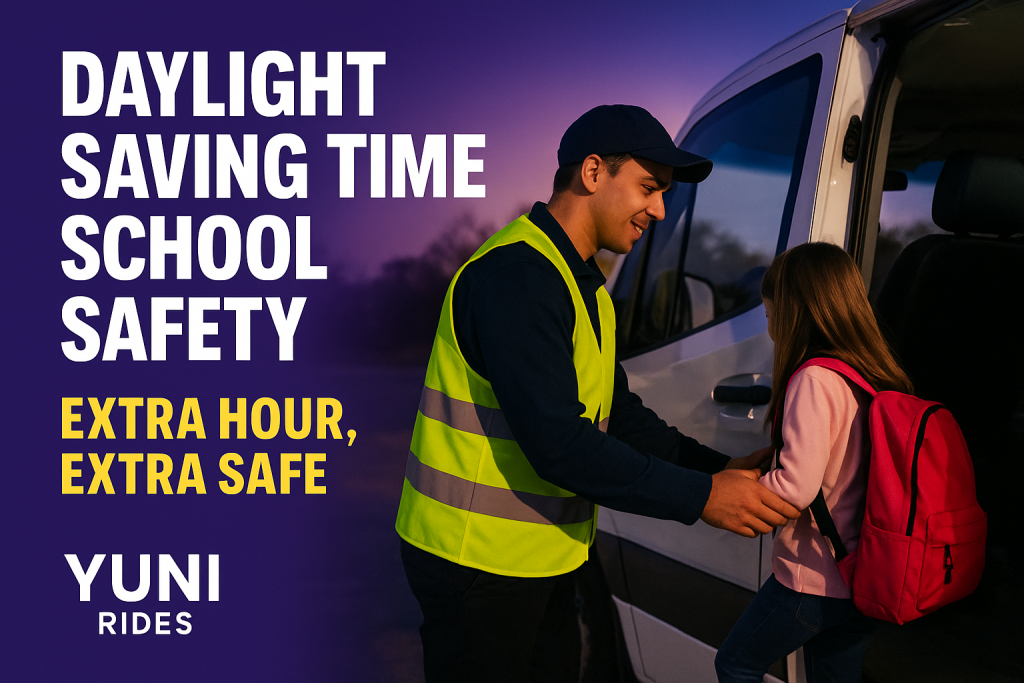
 As the clocks fall back and evenings darken earlier, families and school transport providers face a critical challenge affecting every daylight savings drive: reduced visibility, shifting sleep cycles, and different traffic patterns. When Daylight Saving Time (DST) ends, Yuni Rides doubles down—not only updating schedules, but increasing safety checks, driver training, and parent communications so every child’s commute remains calm, on time, and secure.
Below is a practical, evidence-based guide for parents, schools, and drivers—including what we do at Yuni Rides and how you can help maintain safety during the daylight savings drive through darker months.
Why Every Daylight Savings Drive Requires Extra Vigilance
Although the “fall back” clock change gives most people an extra hour of sleep, it creates significant challenges for school transportation safety. Research from the University of Colorado Boulder shows that fatal car crashes increase by 6% during the week following the spring DST transition, with effects lasting up to two weeks as bodies adjust to the disruption.
While the spring transition receives more attention due to lost sleep, the fall change brings its own risks: studies published in Accident Analysis & Prevention found that road accidents jumped 16% on the first day of DST changes and another 12% on the second day.
The Hidden Danger of the Evening Daylight Savings Drive
The most critical impact occurs when afternoon school commutes suddenly shift into dusk or darkness. According to Michael Flannagan, associate research professor at the University of Michigan, “You do see a big jump in pedestrian fatalities and injuries in the evenings in the fall, when the change back to standard time makes the evenings suddenly darker.”
Children’s travel risk is not only about seat belts or vehicle type—it’s also about timing and environment. NHTSA data shows that while bus occupants have extremely low in-vehicle fatality rates (0.2 fatalities per 100 million vehicle miles traveled versus 1.5 for passenger cars), many school-commute tragedies happen outside the bus during loading and unloading.
According to the Transportation Research Board, about 100 students die each year walking to and from school, and nearly 25,000 are injured—with nearly one in four child pedestrian deaths taking place between 3 and 7 p.m., precisely when the daylight savings drive becomes most hazardous.
Key takeaway: DST doesn’t change how safe buses or trained drivers are—it changes the environment around them. That’s where preventive action matters most for every daylight savings drive.
Four Critical Challenges Every Daylight Savings Drive Faces
Understanding these challenges is essential for maintaining safety:
1. Earlier Darkness = Worse Visibility
The most immediate impact of the daylight savings drive: afternoon dismissals now occur during dusk or darkness. Drivers and pedestrians have less ambient light during peak pickup/drop-off times, making reflective clothing and active lighting critical safety tools rather than optional accessories.
2. Sleep Schedule Disruption
Children may feel drowsier in the morning or evening for several days after the time change. The AAA Foundation for Traffic Safety reports that drivers who miss between one to two hours of the recommended seven hours of sleep nearly double their risk for a crash.
While the fall transition gives an “extra hour,” sleep expert Timothy Morgenthaler, co-director of the Mayo Clinic’s Center for Sleep Medicine, emphasizes that gaining or losing an hour affects sleep patterns for about five to seven days—directly impacting the safety of every daylight savings drive.
3. Higher Risk Time Windows
Afternoon and evening commutes now fall into dusk or dark, increasing exposure to drivers with poor night vision habits. AAA research shows that although only 9% of driving occurs from sunset to sunrise, nearly 49% of fatal crashes occur during that time.
4. Driver Transition Fatigue
Even well-trained drivers may need re-alerting to low-light protocols after the time change. Maintaining daylight savings drive safety requires intentional preparation, not just schedule adjustments.
What Yuni Rides Does for Every Daylight Savings Drive — The Extra Hour Safety Protocol
We treat the clock change as a safety event—not a scheduling annoyance. Our comprehensive approach to protecting every daylight savings drive includes:
Enhanced Driver Awareness Training
Short refreshers before the transition covering:
- Low-light scanning techniques for safer daylight savings drive conditions
- Pedestrian anticipation in darker conditions
- School zone approach protocols
- Headlamp effectiveness checks
AAA recommends specific night-driving practices including increased following distance (since visibility is limited to 250 feet with low beams and 500 feet with high beams), clean windshields to reduce glare, and properly aimed headlights—all essential for safe daylight savings drive operations.
Routine Sleeping-Child Checks
At the end of each route, drivers perform a standardized in-vehicle safety sweep (visual inspection plus app checklist) to confirm no child remains unattended—a critical protocol especially during daylight savings drive periods when darker conditions can make visibility more challenging. Parents receive automated confirmation via SMS.
Lighting & Vehicle Readiness
Pre-shift inspection checklist enforced across our fleet for every daylight savings drive:
- Headlight brightness and alignment verification
- Fog lamp functionality
- Reflective decal visibility
- Interior lighting adequacy
- Windshield and mirror cleanliness
According to AAA research, badly yellowed headlights generate as little as 20% of the light provided by new ones, which critically compromises safety during the daylight savings drive.
Staggered Dispatch Windows
For routes where streets are darker earlier after DST ends, we adjust dispatch and arrival windows slightly to avoid peak dusk during the most vulnerable walk-to-school segments, improving overall daylight savings drive safety.
Parent Communication & Sleep Tips
We send DST-focused guidance to families to help children adapt sleep schedules gradually:
- Earlier bedtimes in 15-minute increments starting 3-4 days before the change
- Morning sunlight exposure recommendations
- Screen time reduction in evening hours
These adjustments help children stay alert and safe during the daylight savings drive period.
Visibility Add-Ons
We provide reflective backpack bands and driver-worn high-visibility vests during the darker months—simple tools that dramatically improve daylight savings drive safety.
Five Evidence-Based Safety Actions for Schools During Daylight Savings Drive
Maintaining daylight savings drive safety requires partnership between providers, schools, and families:
1. Adjust Student Sleep Schedules Before DST
Begin 3-4 days before the clock change: move bedtime earlier by 10-15 minute increments. Research shows gradual transitions reduce morning grogginess and help children adjust faster, which directly impacts their alertness during the daylight savings drive.
2. Require Reflective Gear for All Students
Mandate reflective backpack bands, vests, or light-up accessories for any walking portions of the commute. Fairfax County Public Schools recommends students wear bright colors or clothing featuring reflective fabric, as winter means shorter days and darker conditions—especially critical during the daylight savings drive period.
3. Establish Clear Pickup and Drop-Off Protocols
Confirm exact curbside meeting points with transportation providers. The “danger zone” is considered 10 feet around the vehicle on all sides—students should never walk behind a school vehicle and always make eye contact with the driver before crossing. These protocols become even more essential during the daylight savings drive when visibility is compromised.
4. Communicate with Transportation Providers
Schools should coordinate with drivers to share route concerns, identify poorly-lit areas, and establish emergency protocols. Know driver names, vehicle IDs, and expect “picked up” and “dropped off” confirmations. Transparent communication is fundamental to daylight savings drive safety.
5. Conduct Route Safety Audits
Before DST ends, walk or drive school routes during the new darker timeframe. Identify:
- Areas without adequate street lighting
- Blind corners or curves
- Crossings requiring additional supervision
- Spots where cars frequently back out of driveways
This proactive audit helps schools prepare for daylight savings drive challenges.
Does the daylight savings drive period increase car crashes?
Research from the University of Colorado Boulder analyzing 732,835 accidents from 1996-2017 found a consistent 6% increase in fatal car crashes during the week following the spring DST transition. Studies show road accidents jumped 16% on the first day and 12% on the second day after DST changes. The fall transition also disrupts sleep patterns and creates darker evening commutes, increasing pedestrian risks during every daylight savings drive.
How long do daylight savings drive safety risks last?
Sleep experts note that time change effects typically last five to seven days as circadian rhythms readjust. However, the environmental change—darker afternoon commutes—persists throughout the fall and winter months. This makes ongoing vigilance essential for daylight savings drive safety, not just during the first week after the change.
What should school drivers do differently during daylight savings drive periods?
Drivers should increase low-light scanning, reduce speeds in school zones, ensure lights are clean and properly aligned, and enforce strict handoff confirmations. Yuni Rides drivers receive DST-specific refresher training and complete pre-shift checklists focusing on visibility equipment. AAA recommends cleaning windshields, using high beams appropriately on unlit roads, and maintaining greater following distances at night.
Should schools adjust dismissal times after DST ends?
While schedule changes can help with daylight savings drive safety, most schools maintain consistent times for operational reasons. This makes proper lighting, trained supervision, and enhanced safety protocols—like Yuni Rides' Extra Hour Safety Protocol—essential for protecting students during darker commutes. Some schools do consider staggered dismissals to reduce congestion during low-light conditions.
What technology helps improve daylight savings drive safety?
Technology enhances safety but cannot replace human judgment. Effective tools include live GPS tracking for real-time location monitoring, automated SMS notifications at pickup and drop-off, digital safety checklists to reduce human error, route telemetry identifying poorly-lit segments, and pre-shift inspection apps ensuring vehicle readiness. Yuni Rides combines these technologies with trained human drivers for optimal daylight savings drive safety.
Technology as a Force Multiplier for Daylight Savings Drive Safety
Technology enhances daylight savings drive safety but cannot replace human judgment around children. Yuni Rides uses technology strategically:
- Live GPS tracking for parent peace of mind during every daylight savings drive
- Automated SMS notifications at pickup and drop-off for accountability
- Digital safety checklists to reduce human error in low-light conditions
- Route telemetry identifying poorly-lit segments requiring schedule adjustments
- Pre-shift inspection apps ensuring vehicle readiness for darker drives
This combined model—trained humans supported by smart technology—reduces risk more effectively than either approach alone. Learn more about our driver training programs and parent communication tools.
Yuni Rides’ Daylight Savings Drive Readiness Checklist
Our commitment to daylight savings drive safety includes:
✅ Driver refresher training completed 72 hours before DST ends
✅ All vehicles inspected: lights, wipers, defoggers verified before first post-DST shift
✅ Route darkness mapping: identify stops falling into dusk, apply micro-schedule adjustments
✅ Parent guidance delivered: bedtime adjustment tips and reflective gear recommendations
✅ Sleeping-child confirmation: automated SMS sent after every completed route
✅ High-visibility equipment: reflective vests and bands distributed to drivers and students
Bottom Line: Daylight Savings Drive Safety Is Predictable and Manageable
Daylight savings drive challenges are recurring and predictable—so our response should be too. By combining trained drivers, enhanced vehicle readiness, smart technology for transparency, and simple preventive actions (earlier bedtimes, reflective gear, route audits), we reduce the DST risk window to a manageable event.
Yuni Rides’ promise—Extra Hour, Extra Safe—is a practical pledge: when the clocks fall back, we increase vigilance, improve lighting and safety checks, and communicate clearly so that every child’s daylight savings drive remains calm and secure.
Take Action: Protect Your School’s Daylight Savings Drive
For Parents & Schools:
Want Yuni Rides to conduct a daylight savings drive safety briefing for your school or community? Request a safety workshop or order reflective backpack bands for your students.
For Drivers:
Ready to join a team that takes daylight savings drive safety seriously? Apply to become a Yuni Rides driver and receive comprehensive training for all driving conditions.