
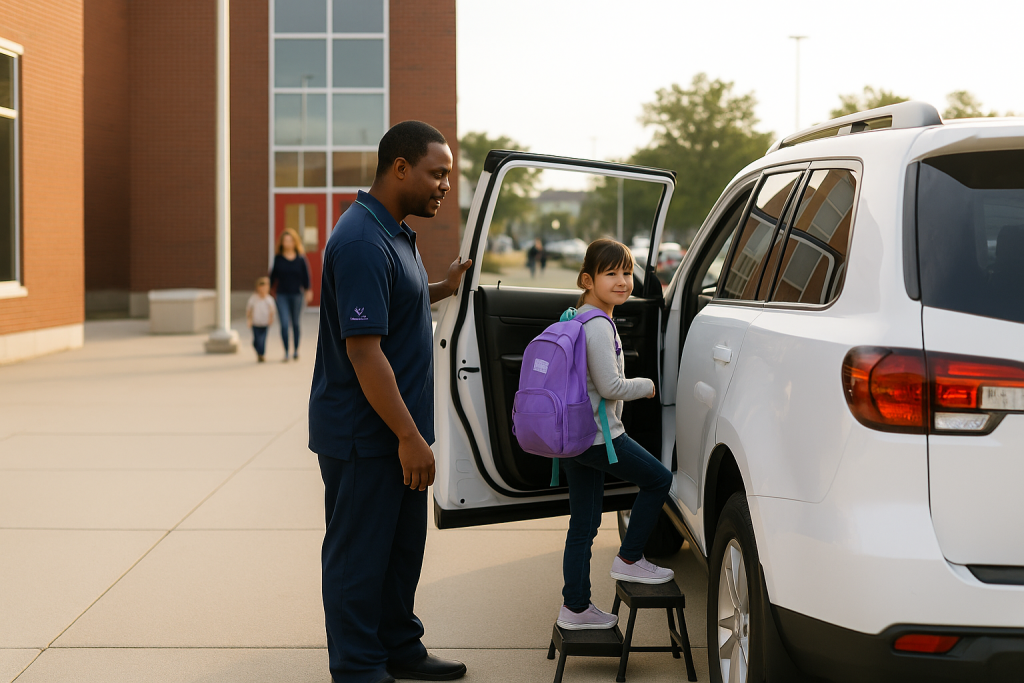
Every school morning, thousands of families place their trust in a stranger’s hands and its even more critical for special needs student transportation.
Not just trust that their child will arrive on time, but trust that the person behind the wheel understands what a meltdown looks like before it happens. Trust that they won’t rush a child who needs an extra moment to process. Trust that if something goes wrong, they’ll know exactly what to do.
For students with special needs, transportation isn’t a logistical detail. It’s the foundation of their entire day.
When it works, students arrive calm, regulated, and ready to learn. When it doesn’t, the consequences ripple through classrooms, homes, and IEP meetings for weeks.
Yet in recent years, many school districts—facing driver shortages, budget cuts, and mounting pressure—have adopted a dangerous shortcut:
“Any driver with a car can transport any child.”
This isn’t just wrong. It’s unsafe.
Special needs student transportation is a specialized discipline. It requires training, consistency, and a depth of human understanding that cannot be outsourced to the lowest bidder or improvised by well-meaning volunteers.
This guide cuts through the noise. It explains what actually matters, where standard transportation models fail, and how providers like Yuni Rides deliver safety that goes beyond compliance—into care.
What “Special Needs Student Transportation” Actually Means and Why It’s Different?
Special needs transportation is not a smaller bus or a separate route.
It is transportation designed around a student’s Individualized Education Program (IEP)—which means every decision, from routing to seating to communication protocols, is built around that child’s specific needs.
According to the U.S. Department of Education’s IDEA guidelines, transportation must be provided as a “related service” when necessary for a student to access their education. That’s not optional. It’s federal law.
But compliance alone doesn’t guarantee quality. True special needs transportation includes:
- Consistent driver assignments to reduce emotional stress and build trust over weeks and months, not days
- Predictable routing and timing to avoid sensory overload, anxiety triggers, or unexpected disruptions that derail a student’s emotional baseline
- Calm, trained guidance for transitions in and out of the vehicle, recognizing that the first and last moments of transport set the tone for everything else
- Awareness of medical, behavioral, or mobility needs that require immediate, informed response—not generic protocols
- Securement and seating standards tailored to each student’s physical and emotional profile, ensuring dignity alongside safety
For many students, even small changes—a different driver, a new vehicle smell, an unexpected detour—can trigger anxiety, shutdown, or behavioral distress.
Reliability isn’t a convenience. It’s a core safety requirement.
When a child knows what to expect, they can regulate. When they can’t, everything unravels. Teachers see it. Parents feel it. And the student lives it.
This is why specialized providers like Yuni Rides prioritize continuity and consistency as non-negotiable elements of service delivery.
Why Standard Rideshare or Taxi Services Cannot Replace Trained Drivers for Special Needs Student Transportation?
Some districts, desperate to fill gaps, have turned to rideshare platforms or taxi services as a temporary fix.
The results have ranged from “barely functional” to “dangerously inadequate.”
Here’s why:
| Factor | Special Needs Transportation Providers | Rideshare / Taxi Model |
|---|---|---|
| Driver Background Requirements | Multi-layer background checks, child-specific clearance, fingerprinting, ongoing monitoring | Standard DMV + criminal background only |
| Training | Special needs behavior support, securement protocols, emergency response, de-escalation techniques | No specialized training |
| Driver Consistency/td> | Same driver assigned daily or weekly | Different driver each ride |
| Accountability | School-district alignment, incident reporting, direct dispatch oversight, real-time communication | No real-time supervision or accountability |
| Vehicle Standards | Wheelchair securement, safety equipment, child-appropriate restraints | Standard passenger vehicles |
This isn’t about judging rideshare drivers. It’s about acknowledging reality: Special Needs Student Transportation is built on predictability as those special needs students would be most affected by it.
A new vehicle. A new voice. A rushed transition. Any of these can completely disrupt a student’s sense of safety—and by extension, their ability to function for the rest of the day.
The National Association for Pupil Transportation (NAPT) has published guidelines specifically warning against using untrained, inconsistent drivers for students with disabilities. The risks aren’t theoretical. They’re documented.
Rideshare platforms weren’t designed for this. And pretending they can handle it puts vulnerable students at risk.
The Comfort and Continuity Factor (The Human Element is the Safety Feature)
Here’s what research tells us:
Driver consistency for special needs students doesn’t just improve logistics—it improves outcomes.
According to studies cited by the National Association for Pupil Transportation, consistent driver assignments lead to:
- Reduced morning anxiety — students recognize the vehicle, the voice, the routine, and can emotionally prepare
- Improved classroom readiness — regulated students can engage with instruction sooner, with fewer transition delays
- Stronger emotional self-regulation — predictability reduces the cognitive load required to “figure out” what’s happening
- Lower rates of behavioral escalation incidents — familiarity reduces triggers and builds trust that prevents crisis
For students who struggle with sensory processing, language shifts, or changes in routine, the driver becomes part of their daily emotional environment.
They’re not just “the person who drives the vehicle.” They’re the calm voice that greets them every morning. The steady presence who knows when to stay quiet and when to engage. The one person outside of school staff who understands their rhythms.
The Autism Society emphasizes that consistency in caregiving—including transportation—is a critical protective factor for students on the spectrum. Disruptions in routine can lead to increased anxiety, aggression, or withdrawal behaviors that persist for hours or even days.
This is why Yuni Rides prioritizes relationship-building, not just routing efficiency.
Technology can optimize a route. Only a human can notice when a child looks overwhelmed—and adjust accordingly.
What Training Actually Matters (Here’s Where Most Providers Fail)
Ask most transportation companies what training their drivers receive, and you’ll get vague answers: “Safety protocols.” “Background checks.” “Compliance training.”
Ask what that training looks like in practice, and the answers get thinner.
At Yuni Rides, training isn’t a checklist. It’s a foundation.
Here’s what it includes:
| Skill Area | What It Means in Practice |
|---|---|
| De-escalation and calm communication | Helping students transition without stress, recognizing early signs of distress (body language, tone shifts, withdrawal), using tone and pacing to regulate emotions rather than escalate them |
| Mobility & securement procedures | Safe, dignified assistance for physical support needs, proper use of adaptive equipment (wheelchairs, car seats, harnesses), respecting personal space and agency while ensuring safety |
| Medical emergency awareness | Recognizing cues for seizures, diabetic episodes, respiratory distress, allergic reactions; knowing escalation steps; staying calm under pressure and communicating clearly with emergency services |
| IEP-based sensitivity and consistency | Treating each student exactly as they are—not as a generic “passenger”; understanding triggers, accommodations, communication preferences, and behavioral plans |
| No-crossing protocol | Ensuring students never cross traffic when boarding or exiting, maintaining visual contact at all times, positioning vehicles to eliminate exposure to moving traffic |
| Sleeping-child verification | Every route ends with a physical seat check—no exceptions, no assumptions. Drivers physically walk through the vehicle after every drop-off. |
This isn’t improvised. It’s structured, tested, and accountable.
And critically: it’s ongoing. Training doesn’t end after orientation. It evolves as drivers gain experience and as students’ needs change.
According to the National Center for Safe Routes to School, driver training programs that include scenario-based learning and ongoing professional development significantly reduce incidents and improve student outcomes. One-time training isn’t enough. Repetition, reflection, and refinement matter.
Yuni Rides incorporates quarterly refresher training, peer learning sessions, and individualized coaching for drivers who work with students with complex needs.
The Legal and Ethical Framework: What Schools Are Required to Provide
Many parents don’t realize that specialized transportation isn’t a “nice to have”—it’s a legal right.
Under the Individuals with Disabilities Education Act (IDEA), school districts must provide transportation as a related service if it’s necessary for a student to access their Free Appropriate Public Education (FAPE).
That means:
- If a student cannot safely or independently access school without specialized transport, the district must provide it
- Transportation must be included in the IEP if it’s deemed necessary by the IEP team
- The service must be provided at no cost to families
- Districts cannot deny transportation due to budget constraints or staffing shortages
Yet many families struggle to get this right enforced. They’re told there’s a waitlist. That rideshare is “just as good.” That their child should take the regular bus “to build independence.”
These responses aren’t just dismissive and for a good reason they are border line illegal.
Parents who face resistance should:
- Request an IEP meeting to formally discuss transportation needs
- Document all communication with the district
- Reference IDEA’s related services requirements explicitly
- Contact a special education advocate if the district continues to deny services
For districts seeking compliant, scalable solutions, partnering with trained providers like Yuni Rides ensures they meet legal obligations while actually supporting students—not just checking boxes.
How Yuni Rides Puts This Into Real Practice
Training matters. But execution is where trust is earned.
Here’s how Yuni Rides translates principles into practice:
1. Same Driver. Same Routine. Same Greeting.
Predictability is emotional safety.
We assign drivers to consistent routes and students, building familiarity and trust over time. When a substitution is necessary, we communicate in advance—giving students and families time to prepare.
Drivers learn each student’s name, their preferences (music or quiet, conversation or silence), and their cues. This isn’t transactional. It’s relational.
2. Flexible Routing — Without Rushed Schedules
We schedule routes to avoid chronic rushing, which reduces stress for everyone: students, drivers, and families.
Tight schedules force compromises. We don’t make them.
Routes are designed with buffer time for students who need extra moments to transition, for unexpected traffic, for the reality that not every morning goes according to plan.
3. Continuous Dispatch Support
Drivers are never alone in managing challenges.
They have real-time communication and guidance from dispatch staff trained to support special needs scenarios. If a student is having a difficult morning, help is a call away—not a policy manual flip-through.
Dispatch can:
- Contact families to coordinate support
- Reroute if needed
- Provide de-escalation coaching in real time
- Document incidents for IEP teams
4. Accountability & Reporting
Schools and families rely on consistent updates—not guesswork.
We document incidents, communicate proactively, and maintain transparent reporting structures that align with district requirements and IEP expectations.
Parents receive notifications when their child is picked up and dropped off. Schools receive incident reports within 24 hours. Nothing is hidden or minimized.
What Parents Often Ask
Can my special needs child ride with other students?
Yes, if their IEP and comfort level support it. Some students benefit from peer presence—it models social behavior, reduces isolation, and creates a sense of normalcy. Others require solo transport to manage sensory overload, behavioral needs, or medical conditions. Decisions are individualized, never forced. The goal is always the child's safety and emotional regulation. If you're unsure what's best, request an IEP meeting to discuss your child's specific needs with the team.
What training do special needs transportation drivers receive?
Drivers receive training in: Special needs behavior support and de-escalation Securement and mobility assistance for wheelchairs and adaptive equipment Emergency procedure readiness (medical and behavioral) Sensitivity and communication techniques tailored to neurodivergent students Safe boarding, exit, and no-crossing protocols Training is ongoing and scenario-based, not just lecture-style compliance. Drivers participate in quarterly refreshers and peer learning sessions.
How do I request special needs transportation for my child?
Contact your school district's transportation coordinator and reference your child's IEP needs. If specialized transportation is not currently provided, request an IEP review meeting. Federal law (IDEA) requires districts to provide transportation as a related service when necessary for a student to access their education. If your district partners with Yuni Rides, you can also reach out directly through our contact page to discuss specific accommodations.
What should I do if my child's transportation provider isn't meeting their needs?
Document everything. Note dates, times, specific incidents, and your child's responses. Request an IEP meeting to address transportation concerns. Bring documentation and be specific about what's not working (inconsistent drivers, rushed schedules, lack of communication, safety concerns). If the district isn't responsive, contact a special education advocate or consider filing a complaint with your state's Department of Education.
Conclusion: Special Needs Students Transportation is not about the logistics, it’s care for those special needs kids.
This work requires humans who understand humans.
A machine cannot notice when a student looks overwhelmed. It cannot reassure a nervous child, adapt tone mid-sentence, smile when it matters, or slow down when the morning feels heavy.
Special needs student transportation works when consistency, trust, training, and compassion are baked into how providers show up—not bolted on as an afterthought.
The difference between a safe ride and a traumatic one often comes down to a single moment: a driver who knows when to wait, when to speak, when to stay silent.
At Yuni Rides, we don’t just drive.
We support a child’s day before it even begins.