
When the School Bus Doesn’t Show: School Bus Alternatives for Illinois
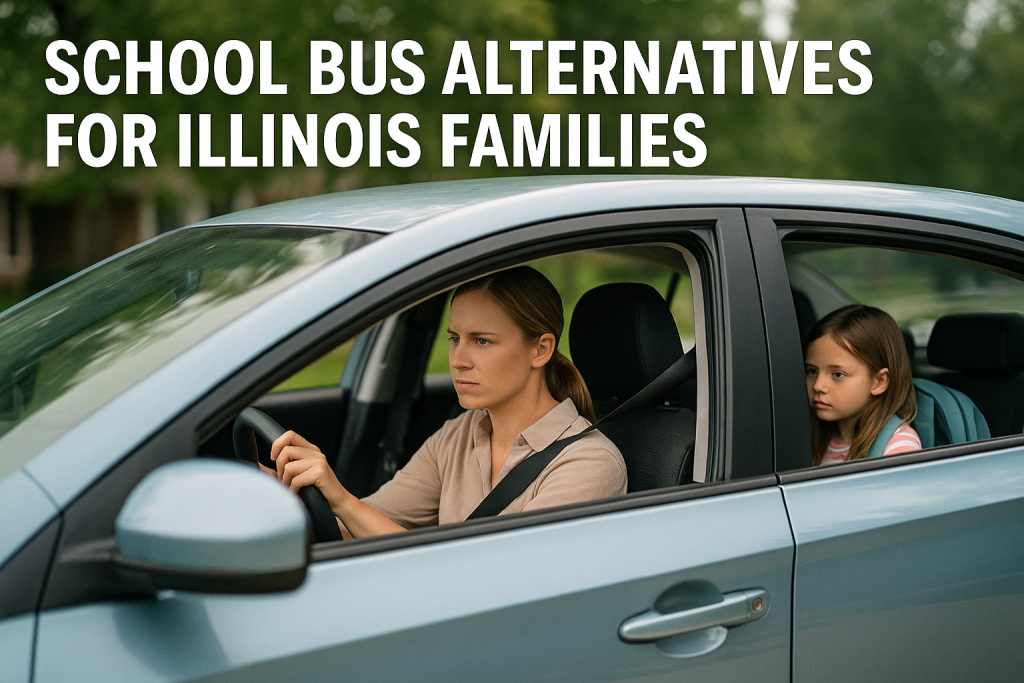
It’s 7:15 AM on a Tuesday morning in Naperville.
Sarah has been standing at the corner with her two kids—Maya, who’s in third grade, and Owen, who has an IEP for autism—for 20 minutes. The bus was supposed to arrive at 7:00 AM. She’s texted the school. She’s called the transportation office. No answer. No bus. No explanation.
By 7:30 AM, Sarah makes a decision she’s made too many times this year: she’s loading both kids into her car, calling her boss to say she’ll be late again, and driving them to school herself. She’ll be 45 minutes late to work. Again. Her manager has already spoken to her twice about it.
This isn’t rare, it is happening across Illinois every single quite frequently and that is why school bus alternatives for Illinois are a must.
According to School Transportation News, 64% of parents find themselves stressing about their child’s transportation needs weekly, including 29% who do so daily. More than three-quarters (79%) say they or their partner/spouse drive their children to and from school. A striking 41% of parents reported that their children’s school district had reduced or eliminated bus services, forcing them to become de facto chauffeurs.
When the school bus doesn’t show in Illinois, families are left scrambling—often with no good options. This guide breaks down what’s actually happening with school bus alternatives for Illinois, why the system is failing, and what parents can realistically do when the bus becomes unreliable or disappears entirely.
The Illinois School Bus Crisis: By the Numbers
If you’re dealing with unreliable school buses in Illinois, you’re not imagining it. The problem is real, it’s widespread, and it’s getting worse.
According to Fox Business reporting on Illinois school transportation, Chicago Public Schools (CPS) has had to prioritize yellow bus transportation for their most vulnerable students—qualifying students with disabilities and students in temporary living situations—because of severe driver shortages. CPS has seen a 22% uptick in the number of students who will be transported on yellow buses compared to the previous year, despite having only 715 of the roughly 1,300 drivers it needs.
The district is operating at about 55% driver capacity. That means nearly half of the drivers needed to run a functional bus system simply don’t exist.
Across Illinois, the situation is similar:
- 91% of school leaders report their transportation operations are constrained by school bus driver shortages
- 60% of school districts have been forced to cut or reduce bus routes
- 41% of Illinois families have lost bus service entirely and now transport children themselves
- 79% of parents are now driving their kids to school or relying on family members
According to research from the Economic Policy Institute, approximately 192,400 bus drivers were working in K-12 schools in September 2023, down 15.1% from September 2019. Employment for state and local government school bus drivers has fallen 13.6% over the same period.
This isn’t a temporary blip. This is a structural crisis, and Illinois families are bearing the burden.
Why the Illinois School Bus System Is Failing Families
Let’s be clear about what’s causing this crisis. It’s not one thing—it’s a combination of factors that have created a perfect storm:
Driver wages haven’t kept pace with living costs.
School bus drivers in Illinois earn an average of $18-$22 per hour, but they typically work split shifts (morning and afternoon only), meaning they’re not getting full-time hours or benefits. Meanwhile, commercial truck drivers—who need the same CDL license—earn significantly more with better hours. Many potential drivers choose trucking over school buses.
Neighboring districts are competing for the same small pool of drivers.
As one Illinois transportation director noted, districts that can’t pay competitively lose drivers to neighboring districts with higher millage rates and better funding. This creates a bidding war that smaller or under-resourced districts can’t win.
The pandemic accelerated retirements and career changes.
Many experienced bus drivers retired during COVID-19 and never came back. Others left for jobs with less public interaction, better benefits, or more predictable hours. The result: a massive experience gap that districts are struggling to fill.
Training new drivers is expensive and time-consuming.
Getting a CDL license and the specific endorsements required for school bus driving costs money and takes time. Some districts have created their own training programs (like AFSCME Local 2040 in East Moline), but many can’t afford to invest in recruitment and training at the scale needed.
Double and triple routes are burning out the drivers who remain.
To cope with shortages, many Illinois districts force existing drivers to do double or even triple runs—picking up one group of students, returning for another, and sometimes a third. This extends morning routes from 1.5 hours to 3-4 hours, leading to exhaustion and more drivers quitting.
The bottom line: Illinois school districts can’t fix this problem quickly, and families can’t wait. That’s why school bus alternatives for Illinois students and families have become essential, not optional.
What Happens When the Bus Doesn’t Show: Real Impact on Families
Let’s talk about what this crisis actually costs families:
Parents are missing work repeatedly.
More than half of surveyed parents admitted that driving their children to and from school has negatively affected their careers, forcing them to adjust work schedules, decline promotions, or forgo job opportunities altogether. Some parents—especially those without flexible employers—are getting written up or fired for chronic lateness.
Families are facing impossible choices.
When one parent has to adjust their entire schedule to become the school driver, the family loses career advancement opportunities and workplace flexibility. Some families can’t make it work at all—they don’t have vehicles, they can’t afford the gas, or their jobs simply won’t accommodate chronic schedule changes.
Kids are missing school.
When transportation falls through and parents can’t drive, kids stay home. This contributes to chronic absenteeism, which research shows has severe academic consequences. According to educational research, over 44% of school leaders identify transportation challenges as a factor contributing to chronic absenteeism—and more than 21% report it’s the biggest contributor.
Special needs students are disproportionately affected.
Students with IEPs are legally entitled to transportation as a related service under federal law. But when districts can’t provide it, families of special needs children face impossible choices: rearrange their entire lives to drive them, keep them home and sacrifice educational services they desperately need, or advocate relentlessly for district-funded alternatives.
Parents’ stress levels are through the roof.
More than half of parents (64%) say they stress about their child’s transportation needs at least once a week. Nearly a third (29%) worry about it daily. This chronic stress affects mental health, relationships, and overall family wellbeing.
This isn’t just inconvenient—it’s a crisis that’s reshaping families’ lives, careers, and finances.
School Bus Alternatives for Illinois students: What Actually Works
When the bus stops showing up, what can Illinois families actually do? Here are the realistic options, with honest pros and cons:
Option 1: Drive Your Kids Yourself (The Default for 79% of Parents)
How it works:
You adjust your schedule to drive your kids to school in the morning and pick them up in the afternoon. This is what most Illinois families are already doing because they have no other choice.
Pros:
- You control the schedule and know your kids arrive safely
- No need to coordinate with others or trust strangers
- Works for families with flexible jobs or one parent who doesn’t work outside the home
Cons:
- Destroys work schedules for most parents (arriving late, leaving early)
- Many employers won’t tolerate chronic schedule changes
- Unsustainable long-term for working parents
- Costly (gas, vehicle wear, time lost from work)
- Some families don’t have reliable vehicles or any vehicle at all
Best for: Families where one parent has extreme schedule flexibility or doesn’t work, and where the school is close to home. This is why many families are exploring school bus alternatives for illinois actively.
Option 2: Carpool with Neighbors or Other Parents
How it works:
You coordinate with other families whose kids attend the same school. Each family takes turns driving all the kids on certain days. For example, if four families carpool, each parent drives one day per week instead of five.
Pros:
- Reduces the burden on any single family
- Builds community connections
- Saves gas and reduces vehicle wear for everyone involved
- Kids often enjoy riding with friends
Cons:
- Requires coordination and reliability from multiple families
- Falls apart if one family can’t commit or drops out
- Doesn’t work if kids have different school start times
- Liability concerns (what if there’s an accident while you’re driving someone else’s child?)
- Difficult to find compatible families in your area
Best for: Families in neighborhoods with multiple kids attending the same school, where parents can commit reliably and schedules align.
For drivers considering this as work:
Some parents in carpool situations eventually ask, “What if we coordinated with others who need similar support?” That’s where professional student transportation opportunities come in—turning community needs into meaningful work.
Option 3: Before-School or After-School Programs with Transportation
How it works:
Some schools, YMCAs, community centers, or childcare providers offer before-school or after-school programs that include transportation. You drop your kid at the program (which has earlier/later hours than school), and they provide the ride to school.
Pros:
- Shifts the transportation burden to a provider with their own drivers
- Often includes enrichment activities (homework help, sports, arts)
- Provides childcare coverage for working parents with long hours
- May be subsidized or free for qualifying families
Cons:
- Not all schools or communities have these programs
- Limited spots—programs often have waitlists
- Doesn’t solve the problem if your child has special needs that programs can’t accommodate
- Program schedules may not align with work schedules
Best for: Families who need extended childcare anyway and whose kids don’t have complex special needs.
Option 4: District-Contracted Private Transportation Services
How it works:
School districts contract with private transportation providers to fulfill their legal obligation to transport students—particularly those with IEPs or special needs. Parents work with their child’s IEP team or school administration to access these district-funded services.
Pros:
- Same driver every day (builds trust and consistency)
- Drivers trained in special needs, IEPs, and safety protocols
- Direct communication with the driver (not going through district bureaucracy)
- Flexible scheduling that accommodates individualized needs
- Specifically designed for students with disabilities who need specialized support
- Families don’t bear the financial burden directly—districts fulfill their legal obligations
Cons:
- Requires advocacy through IEP meetings or school administration
- Not all districts have established contracts with quality providers
- May take time to arrange through proper channels
- Not all families know this option exists or how to access it
Best for: Families with special needs students whose IEPs include transportation as a related service, or families who can work with their school district to arrange appropriate transportation when the school bus isn’t adequate.
Why this option is growing in Illinois:
With district buses unreliable or nonexistent, many Illinois school districts are contracting with private providers to fulfill their legal obligations. For drivers looking for meaningful part-time work, this growing demand creates consistent employment opportunities through district partnerships.
Option 5: Public Transportation (Where Available)
How it works:
In some Illinois cities, older students can take public buses or trains to school. This requires teaching your child the route, ensuring they can navigate independently, and coordinating schedules.
Pros:
- Inexpensive (often free or discounted student fares)
- Teaches independence and navigation skills
- Available in urban areas like Chicago
Cons:
- Only works for older, independent students (typically middle or high school)
- Not available in suburban or rural Illinois communities
- Safety concerns (kids traveling alone in public transit)
- Doesn’t work for special needs students who need supervision
- Unreliable schedules can cause missed school time
Best for: Older, independent students in Chicago or other cities with robust public transit, where parents are comfortable with their child traveling alone.
Option 6: District Transportation Stipends (Where Offered)
How it works:
Some Illinois districts (like CPS) offer monthly stipends to families who arrange their own transportation when the district can’t provide adequate service.
Pros:
- Provides some financial help to offset transportation burdens
- Gives families flexibility to arrange whatever works for them
- Acknowledges the district’s inability to fulfill transportation obligations
Cons:
- Stipend amounts often don’t cover actual costs or lost work time
- Doesn’t help families who don’t have cars or can’t drive themselves
- Payment delays have been reported in some districts
- Doesn’t solve the problem—just shifts the burden to parents with partial compensation
Best for: Parents who are already driving their kids and want some reimbursement, but not families who need actual transportation solutions.
What Illinois Drivers Need to Know About This Opportunity
If you’re reading this as an Illinois resident wondering, “Could I help solve this crisis?” the answer is probably yes—and the demand is overwhelming.
Illinois currently needs hundreds of qualified drivers across the state. Districts can’t fill positions fast enough, and many are contracting with private transportation providers to meet their legal obligations. Here’s what you need to know:
The need is real and growing.
With 91% of districts reporting driver shortages and 60% cutting routes, there’s more work available than people to do it. Districts are actively seeking partnerships with reliable providers, and those providers need qualified drivers. If you have a clean driving record, patience with kids, and a few hours in the morning and afternoon, you can start earning income quickly while solving a genuine crisis for families.
You don’t need a CDL for private student transportation.
While district bus drivers need a Commercial Driver’s License, most private transportation providers working with districts use regular passenger vehicles—meaning your standard driver’s license is sufficient. This dramatically lowers the barrier to entry. Learn more about what student transportation driver requirements you actually need to meet.
Work is consistent and meaningful.
When districts contract with private providers, drivers get consistent routes for the entire school year—not gig economy chaos. You know your schedule, you know your students, you build relationships. Illinois drivers for student transportation typically earn $18-$25 per hour, with morning routes (6:30-9:00 AM) and afternoon routes (2:00-4:30 PM). Many drivers work both blocks for 20-30 hours per week, while others just do mornings or afternoons. It fits around VA appointments, family commitments, or other part-time work. For more details, see how much school transportation drivers actually make.
You’re filling a gap districts can’t fill.
CPS needs 585 more drivers. Suburban and downstate districts are similarly short-staffed. When you become a driver for student transportation, you’re providing a service that the public system physically can’t deliver right now. That’s why drivers with military, healthcare, or caregiving backgrounds often find this work particularly rewarding—you’re serving your community in a tangible way.
The training is thorough and the work is meaningful.
You’ll be trained in child safety, special needs support (if working with IEP students), communication protocols, and emergency procedures. You’re not just driving—you’re becoming a trusted part of families’ daily lives. Parents will specifically request you by name. Kids will wave when they see you at the grocery store. That sense of purpose is why many drivers stick with this work long-term.
How to Evaluate School Bus Alternatives for Illinois
If you’re a parent choosing between these options, here’s how to evaluate what will actually work:
Ask yourself these questions:
- Does my child have an IEP or special needs?
If yes, transportation is a legal right. Work with your IEP team to ensure the district provides or arranges appropriate transportation. Private providers contracted by districts are often the solution when school buses can’t accommodate your child’s needs. - How flexible is my job?
If your employer tolerates chronic lateness or schedule changes, you might survive driving your kids yourself. If not, you need an alternative that doesn’t depend on your availability. - Do I have reliable transportation?
If you don’t own a car or your car frequently breaks down, driving yourself isn’t sustainable. You need an external solution. - Is there a carpool or before-school program in my area?
If yes, explore those first—they may offer community support or be subsidized. If no, or if they don’t work for your situation, explore what your district can arrange. - Can my child’s IEP cover transportation services?
If your child has an IEP and the district can’t provide appropriate transportation, this is legally required under federal law (FAPE—Free and Appropriate Public Education). Advocate for the district to arrange suitable alternatives.
Why Yuni Rides Works with Illinois School Districts
At Yuni Rides, we’ve watched Illinois families struggle as district buses become unreliable or disappear entirely. We partner with school districts to help them fulfill their transportation obligations when they can’t do so with traditional buses.
Here’s what school bus alternatives for Illinois look like through district partnerships with Yuni Rides:
✅ Same driver, every day – Students build trust with a consistent person
✅ Trained for special needs – IEP support, autism accommodations, behavioral protocols
✅ Small groups (1-3 kids) – Calm environment, not a crowded bus
✅ Curbside handoff required – No child left unattended
✅ Direct parent communication – Parents can reach drivers directly
✅ Flexible scheduling – Routes accommodate individualized needs
✅ Background-checked drivers – Every driver thoroughly vetted
✅ Backup plans in place – Clear protocols for substitutes and emergencies
We serve families across Illinois—Chicago, suburbs, and downstate communities—through partnerships with school districts. If you’re a parent whose child needs reliable transportation, work with your school’s administration or IEP team to explore district-funded options. If you’re someone in Illinois considering becoming a driver who helps solve this crisis, we’d like to hear from you.
Frequently Asked Questions About School Bus Alternatives for Illinois
Why can't Illinois districts just hire more bus drivers?
They're trying, but there aren't enough qualified people applying. Low pay, split shifts, lack of benefits, and CDL requirements all contribute. Commercial trucking and other industries pay more for the same license, making it hard to compete.
How do I access district-funded transportation for my child with special needs?
Work with your child's IEP team during annual reviews or call an IEP meeting specifically to address transportation. If the school bus isn't appropriate for your child's needs, the district is legally required to provide suitable alternatives under FAPE (Free and Appropriate Public Education)
What if my child doesn't have an IEP but the bus route was canceled?
Contact your school district's transportation office to understand your options. Some districts offer stipends, adjust schedules, or work with contracted providers to serve general education students when buses aren't available. Advocacy matters, districts respond when parents organize and make their needs known.
Can I use the $500 CPS stipend if offered?
Yes, if you're in Chicago and your child qualifies. However, understand that accepting the stipend typically means waiving your right to district-provided transportation. Consider whether the stipend adequately covers your actual costs and whether you have the capacity to drive consistently.
What if I can't afford any of these alternatives and my district isn't helping?
Document everything like missed buses, late arrivals, communication attempts with the district. Contact your school board representatives and attend board meetings. Connect with other affected parents to advocate collectively. In some cases, legal advocacy through special education attorneys may be necessary, especially for students with IEPs.
How do I find district-contracted transportation providers in Illinois?
Ask your school district's transportation office which providers they work with. Not all districts advertise these partnerships, but many have them. If your district doesn't have contracts in place, advocate for them to establish partnerships that can help meet transportation needs.
Illinois parents: Need help navigating transportation options for your child?
Yuni Rides works with school districts to provide specialized transportation. Contact your school administration about district partnerships.
→ Contact Us: (415) 535-2155
Looking for special needs transportation in Chicago?
See how district partnerships support IEP students with individualized protocols and trained drivers.
→ Chicago Special Needs Transportation
Want autism-specific transportation support?
Explore our guide to autism-friendly school transportation and what makes drivers successful.
→ Autism-Friendly Transportation
Illinois drivers: Want to help solve this crisis?
Learn how to become a student transportation driver and support your community through meaningful work.
→ Become a Driver
When the school bus doesn’t show in Illinois, families need reliable alternatives.
For parents: Work with your district to access appropriate transportation. For drivers: Your community needs you.